
Today’s vehicles are smarter than ever. They rely heavily on electronics and software. However, vehicles still interact with the real world through physical signals. This is where signal converter play a key role.
Signal converters, such as Analog-to-Digital Converters (ADCs) and Digital-to-Analog Converters (DACs), help vehicles understand real-world data. In simple terms, they convert sensor signals into usable digital data for control systems.
Industrial signal converters, like the ones offered by Kathirsudhir Automation, are widely used across many automotive applications. They ensure accuracy, reliability, and safety.
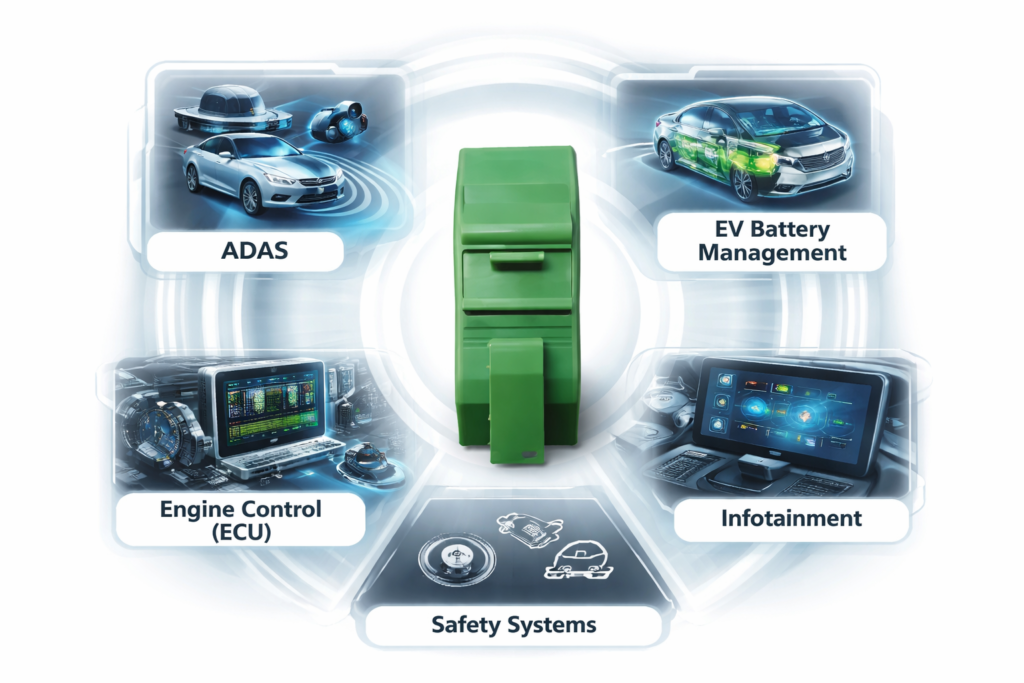
Signal Converters in Automotive Systems: A Simple Overview
In vehicles, most sensors produce analog signals. For example, temperature, pressure, speed, and position sensors all send analog data. However, Electronic Control Units (ECUs) only understand digital signals. Therefore, s/g conversion act as a bridge between sensors and ECUs. As a result, vehicles can make fast and accurate decisions in real time.
Understanding Analog-to-Digital Conversion in Vehicles
First of all, Analog-to-Digital Converters (ADCs) convert changing physical signals into digital values. These values are then processed by the ECU.
Without ADCs, modern vehicles could not function properly. In fact, every smart automotive feature depends on accurate signal conversion.
Moreover, signal conversion help reduce noise and signal loss. This is especially important in harsh automotive environments.
Common Types of ADCs Used in Automotive Systems
Different automotive systems need different ADC types. Therefore, manufacturers use several kinds of ADCs.
- SAR ADCs
These are fast and reliable. As a result, they are widely used in sensor monitoring. - Sigma-Delta ADCs
These provide very high accuracy. Therefore, they are ideal for battery and pressure monitoring. - Pipeline ADCs
These are used in high-speed systems. For example, radar and camera-based ADAS systems rely on them.
Industrial signal converters often combine these technologies for better performance.
Improving Vehicle Safety Using Signal Converters
Vehicle safety depends on correct data. Even a small error can cause big problems. Therefore, signal accuracy is critical.
It help by:
- Reducing electrical noise
- Protecting ECUs through isolation
- Ensuring fast data conversion
As a result, systems like braking and collision avoidance work more reliably.
Improving Vehicle Performance with ADCs
In addition to safety, performance also depends on good data. For example, fuel efficiency and engine smoothness rely on sensor feedback.
With accurate signal converters:
- Engines run more efficiently
- Energy usage is optimized
- Response times improve
Therefore, signal converters directly improve vehicle performance.
Real-World Automotive Applications of Signal Converter
S/G converter are used in many automotive systems. Let us look at some key areas.
Signal Converter in Advanced Driver-Assistance Systems (ADAS)
ADAS systems depend on sensors like:
- Radar
- LiDAR
- Cameras
- Ultrasonic sensors
These sensors send analog signals. However, ECUs need digital data. Therefore, signal converters are essential.
As a result, features such as:
- Adaptive cruise control
- Lane-keeping assist
- Automatic emergency braking
can react quickly and accurately.
Signal Converter in Engine Control Systems (ECUs)
Engine ECUs collect data from many sensors. For example:
- Oxygen sensors
- Temperature sensors
- Airflow sensors
- Throttle position sensors
It change these analog signals into digital data. Then, the ECU uses this data to:
- Control fuel injection
- Adjust ignition timing
- Reduce emissions
Therefore, signal converters help engines run cleaner and better.
Other Important Automotive Areas Using Signal Converter
In addition to ADAS and ECUs, s/g converter are also used in:
Electric Vehicle Battery Management Systems
They monitor:
- Cell voltage
- Current
- Temperature
As a result, batteries stay safe and last longer.
Chassis and Stability Control
Systems like ABS and ESC rely on fast and accurate sensor data.
Infotainment and Connectivity
They convert audio signals for:
- Voice control
- Media playback
- Vehicle-to-everything (V2X) communication
Telematics and Power Management
It helps to connect older analog sensors to modern digital networks like CAN bus.
Why Industrial Signal Converter Matter in Automotive Applications
Automotive environments are tough. They include vibration, heat, and electrical noise.
Products like the Signal Converter from Kathirsudhir Automation offer:
- High accuracy
- Strong isolation
- Wide input and output support
- Long-term reliability
As a result, they are suitable for both OEM and automation-based automotive systems.
Conclusion
In conclusion, It is essential in modern vehicles. They connect the physical world to the digital control systems. From ADAS and engine control to EV batteries, infotainment, and telematics, signal converters ensure safe and efficient operation. Therefore, choosing reliable industrial signal converters is critical. With solutions from Kathirsudhir Automation, automotive systems can achieve better safety, performance, and future readiness.