
A parking alert control system is used wherever vehicles need to park safely, accurately, and efficiently. In simple terms, it helps drivers avoid hitting walls, pillars, or other vehicles. At the same time, it improves traffic flow and uses parking space better. Because of these benefits, parking alert control systems are now common in buildings, industries, and smart cities. Today, many facilities rely on advanced solutions like the Vehicle Parking Alert & Control System from KathirSudhir Automation to reduce accidents and manage vehicle movement.
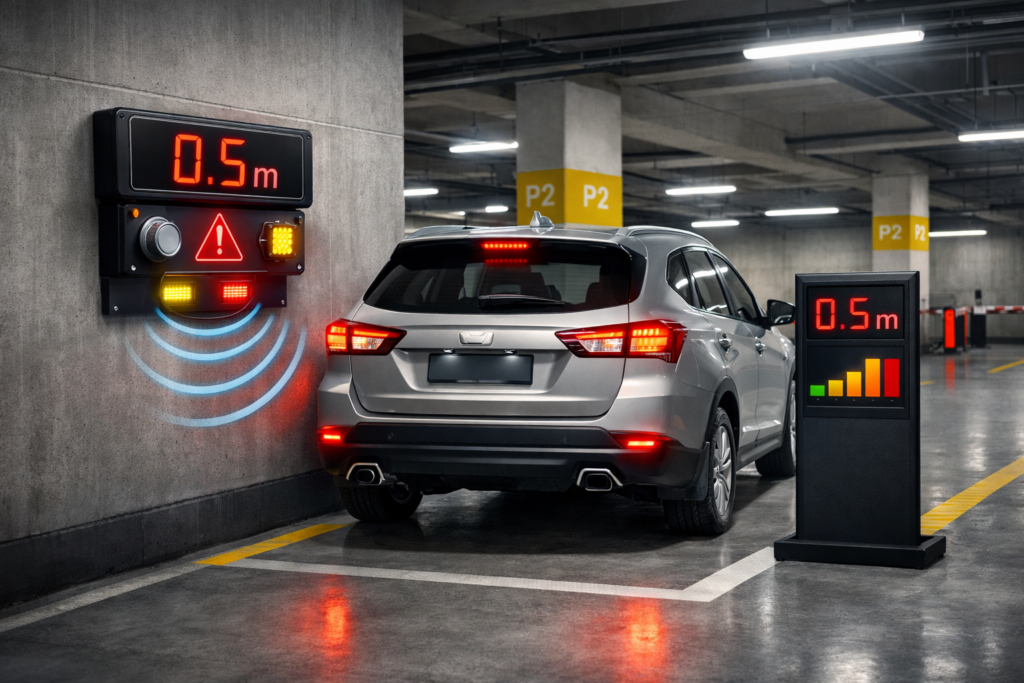
Key Application Areas of Parking Alert Control Systems
Commercial & Public Infrastructure
Firstly, parking alert systems are widely used in shopping malls, hospitals, airports, hotels, and office buildings.
These locations experience high vehicle movement every day.
As a result, even small parking errors can cause damage or delays.
Therefore, parking alert systems guide drivers to stop at the right point.
They also reduce repair costs and improve user experience.
Smart Parking & Urban Planning
Secondly, smart cities use parking alert systems to manage limited parking space. These systems work with IoT sensors to show real-time parking availability. Because of this, drivers spend less time searching for parking. Consequently, traffic congestion and fuel waste are reduced. In addition, mobile apps can display available slots instantly.
Residential & Gated Communities
In residential buildings, parking space is often limited.
For this reason, parking alert systems are installed in basements and tight areas.
They help residents park without damaging walls or other vehicles.
Moreover, RFID or sensor-based access improves security.
As a result, only authorized vehicles can enter.
Industrial & Logistics Facilities
In factories and logistics hubs, vehicle safety is critical. Forklifts and trucks move continuously in confined spaces. Therefore, parking alert control systems guide vehicles during docking. They also prevent damage to docks, racks, and loading bays. Most importantly, they improve worker safety and operational efficiency.
Vehicle-Integrated Applications
Parking alert systems are also used directly on vehicles.
For example, ultrasonic sensors are fitted on front and rear bumpers.
These sensors detect obstacles while parking.
As a result, drivers receive instant warnings.
This significantly reduces minor accidents.
Specialized Security & Restricted Zones
Finally, these systems help monitor restricted parking areas. They identify unauthorized or overstaying vehicles. In addition, they protect VIP and reserved parking spaces. Because of this, overall parking discipline improves.
How Do Parking Sensors Work?
Parking sensors work by measuring the distance between a vehicle and nearby objects.
They send ultrasonic waves toward obstacles.
When the waves return, the system calculates the distance.
If the vehicle gets too close, an alert is triggered.
This alert can be sound, light, or both.
Working Principle of Parking Sensors
To begin with, the sensor emits ultrasonic signals. Next, the signal hits an obstacle and reflects back. Then, the controller measures the time taken. After that, the system calculates the distance. Finally, warnings activate when limits are crossed.
Main Functions of Parking Sensors
- Detect nearby obstacles
- Measure safe stopping distance
- Provide audio and visual alerts
- Guide drivers during parking
- Improve safety and accuracy
Basic Components of a Parking Alert Control System
| Component | Function |
|---|---|
| Ultrasonic Sensor | Detects object distance |
| Controller Unit | Processes signals |
| Alarm/Buzzer | Warns the driver |
| Display Unit | Shows distance |
| Power Supply | Runs the system |
| Communication Output | Connects to automation |
Vehicle Backup Camera – Explained Simply
A vehicle backup camera shows a live video of the rear area. This helps drivers see obstacles clearly. However, it depends on lighting and visibility. Therefore, cameras work best when combined with sensors. Together, they provide better parking safety.
Parking Sensor vs Backup Camera
| Feature | Parking Sensor | Backup Camera |
|---|---|---|
| Detection Type | Distance-based | Visual |
| Works in Low Light | Yes | Limited |
| Driver Attention | Low | High |
| Industrial Use | Very good | Limited |
Modern Advances in Parking Assistance Technology
Today, parking technology is more advanced than ever.
For example, systems now support IoT connectivity.
They also send SMS or app alerts.
In addition, many systems integrate with EV charging stations.
As a result, parking becomes smarter and safer.
Usage Checklist
✔ Tight parking spaces
✔ Basement parking
✔ Industrial docking zones
✔ High-traffic areas
✔ EV charging stations
Simple Implementation Steps
- Identify risk zones
- Select correct sensor range
- Set alert limits
- Install alarms and displays
- Test emergency features
- Train users and drivers
Recommendations
To summarize, parking alert control systems are essential for modern parking. They reduce accidents and save costs. They also improve traffic flow and safety. For best results, combine sensors with displays or cameras. Additionally, choose weatherproof and industrial-grade systems.
FAQs
1. Where are parking alert control systems used?
They are used in malls, hospitals, airports, industries, homes, and smart cities.
2. Are parking sensors useful in industrial areas?
Yes, they guide trucks and prevent damage in factories and warehouses.
3. Can parking alert systems work in basements?
Yes, they are ideal for dark and tight basement parking areas.
4. What is better: parking sensor or backup camera?
Both are best used together for maximum safety.
5. Do parking alert systems reduce accidents?
Yes, they significantly reduce low-speed parking accidents.
6. Are these systems suitable for EV charging stations?
Yes, they help vehicles align correctly and avoid charger damage.
7. What sensor range is ideal for parking systems?
Typically, a range of 0.3 m to 2 m works best.
8. Are parking alert systems weatherproof?
Most industrial systems are IP65-rated for outdoor use.
9. Can alerts be customized?
Yes, alerts can be set for different distances and zones.
10. Are parking alert systems part of smart cities?
Yes, they are a key element of smart parking infrastructure.