
Digital angle inclinometer are vital tools in railway technology because they measure tilt, slope, and alignment with high accuracy. As a result, engineers can detect track and structural issues early. Moreover, these sensors support both real-time monitoring and long-term safety planning. Therefore, they play a key role in accident prevention and efficient railway operations.
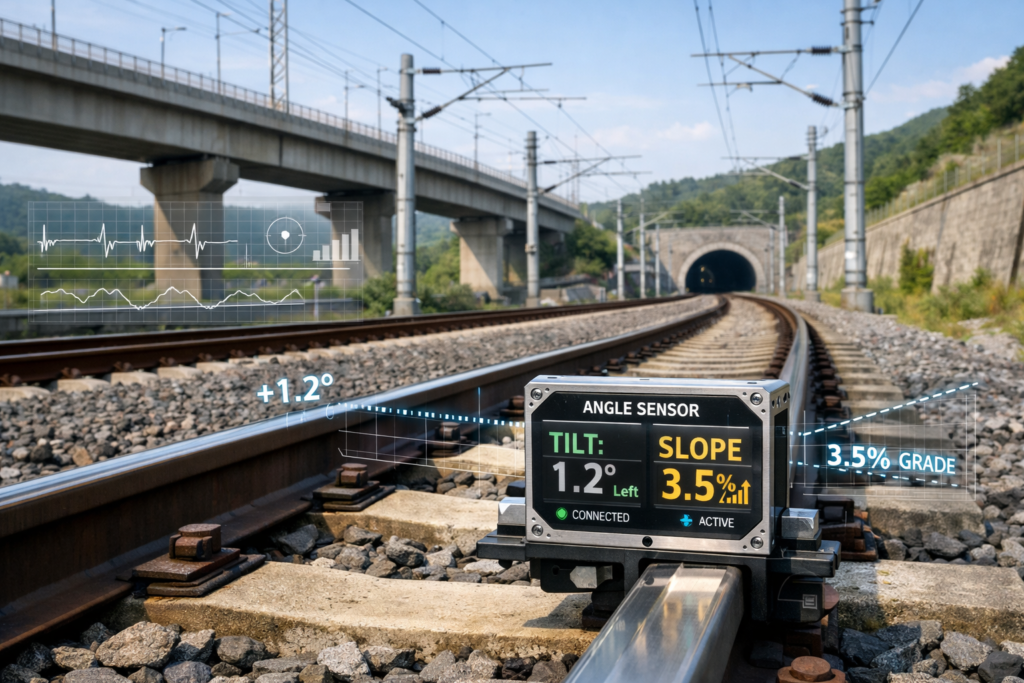
Railway Infrastructure Monitoring & Accident Prevention
Railway safety depends on precise geometry. Even small errors can cause major risks. For example, incorrect cant or slope can lead to derailments.
Because of this, digital angle inclinometers are widely used. They continuously track rail cant, twist, and tilt. As a result, maintenance teams receive early warnings. Consequently, corrective actions can be taken before accidents occur.
What Is a Digital Angle Inclinometer?
A digital angle inclinometer is a sensor that measures angular tilt relative to gravity. Usually, it uses MEMS or electrolytic technology. Then, it converts movement into digital signals. Unlike manual tools, digital inclinometers are faster and more accurate. In addition, they reduce human error. Therefore, they are ideal for modern railway projects. Industrial solutions from Kathirsudhir Automation are built for harsh railway environments and automation needs.
An Ideal Monitoring Solution for Railways
An effective railway inclinometer should be accurate and stable. At the same time, it must resist vibration and temperature changes. Furthermore, it should support continuous data logging. Because of these features, railway operators gain reliable and long-term monitoring.
Advantages of Digital Angle Inclinometer in Railway Monitoring
First, they provide real-time measurements.
Next, they help predict failures early.
Additionally, they improve maintenance planning.
Finally, they enhance passenger and asset safety.
As a result, overall operating costs are reduced.
Applications in Railway Monitoring
Digital angle inclinometers are used in many railway areas, such as:
- Track alignment and sleeper leveling
- High-speed rail cant measurement
- Slope and embankment stability checks
- Bridge and tunnel tilt monitoring
- Retaining wall deformation analysis
For instance, they help during construction alignment checks. Later, they remain in place for long-term monitoring.
Comparison Table
| Aspect | Traditional Methods | Digital Angle Inclinometer |
|---|---|---|
| Accuracy | Medium | Very High |
| Data Access | Manual checks | Real-time data |
| Automation | No | Yes |
| Monitoring Type | Periodic | Continuous |
| Safety Response | Reactive | Preventive |
Key Aspects to Consider
- Accuracy and resolution
- Environmental protection
- Output compatibility
- Long-term stability
Therefore, choosing the right model is essential.
Usage in Railway Projects
During construction, inclinometers verify track levels. After commissioning, they monitor structures continuously. In addition, they support safety audits and compliance checks.
Key Application Areas
- High-speed rail corridors
- Metro rail systems
- Mountain railway routes
- Railway bridges and tunnels
Because these areas face higher risks, monitoring is critical.
Steps to Follow for Implementation
- Identify critical monitoring points
- Select suitable accuracy and range
- Install the sensor securely
- Calibrate correctly
- Connect to monitoring software
- Set alert thresholds
After that, review data regularly.
Checklist for Implementation
✔ Accuracy defined
✔ Environment assessed
✔ Data logging planned
✔ Alarm limits set
✔ Maintenance plan ready
Practical Examples
For example, engineers monitor rail cant on high-speed lines. Similarly, embankments are tracked in landslide-prone areas. In addition, bridge tilt is monitored for early warning.
Key Features and Technology
- MEMS or electrolytic sensors
- Digital output
- Real-time monitoring
- Compact industrial design
- Automation-ready interfaces
Advantages and Disadvantages
Advantages
- High precision
- Fast response
- Early fault detection
- Reduced downtime
Disadvantages
- Higher initial cost
- Needs proper calibration
Required Components
- Digital angle inclinometer
- Mounting accessories
- Power supply
- Data acquisition system
- Communication interface
Frequently Asked Questions:
- Why are digital inclinometers used in railways?
Because they ensure accurate alignment and structural safety. - Can they help prevent accidents?
Yes, early warnings reduce derailment risks. - Are they suitable for high-speed rail?
Yes, high-speed rail requires precise geometry control. - Do they work outdoors?
Yes, industrial models handle harsh conditions. - What parameters do they measure?
Tilt, slope, cant, and angular movement. - Can they monitor embankments?
Yes, they detect settlement and lateral movement. - Do they support automation systems?
Yes, many integrate with PLC and SCADA. - Are they accurate?
Yes, they offer high resolution and repeatability. - Do they reduce maintenance costs?
Yes, predictive monitoring lowers repair expenses. - Are they easy to install?
Yes, most designs are compact and simple to mount.
Conclusion
In conclusion, digital angle inclinometers are essential for safe and efficient railway operations. Because they deliver real-time, high-accuracy data, they help detect problems early. Moreover, they support automation and predictive maintenance. Therefore, they are becoming a standard solution in modern railway infrastructure.