
The battery industry is growing very fast. Electric vehicles, energy storage systems, and electronics all depend on batteries. Because of this growth, manufacturers must produce more batteries in less time. At the same time, they must maintain high quality. However, traditional production systems struggle to meet these demands. Therefore, many manufacturers are now using electric actuator. These devices help improve productivity, reduce cycle time, and ensure consistent quality.
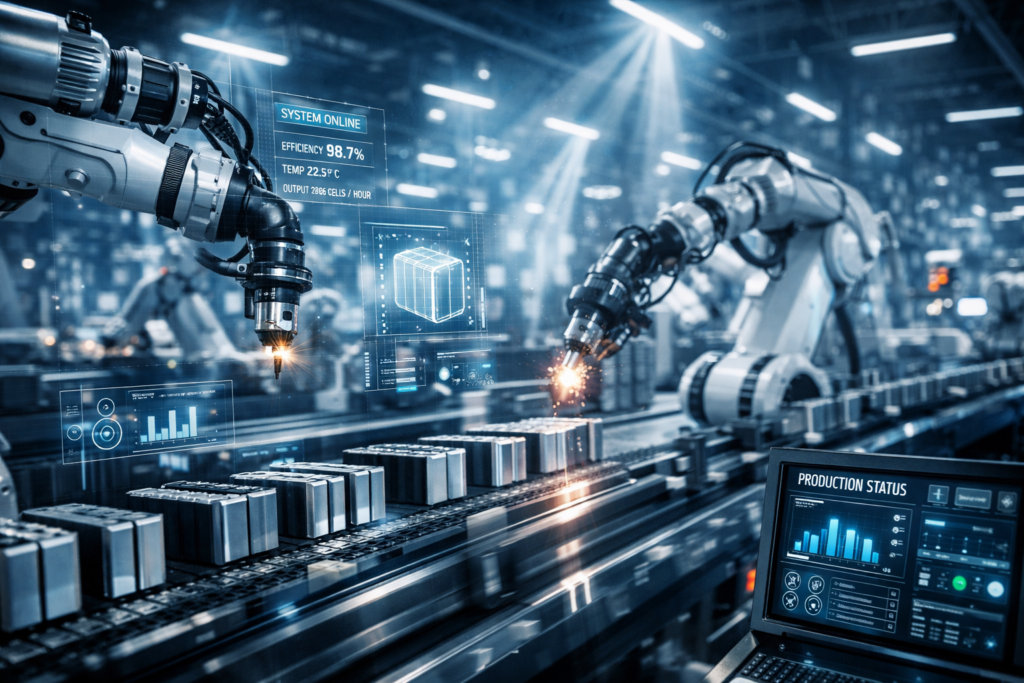
How Electric Actuator Improve Productivity and Reduce Time
High Precision and Repeatability
First of all, battery manufacturing requires extreme accuracy. Even small errors can cause defects. Electric actuators provide very high precision and repeatability. As a result, tasks like electrode stacking and material handling become more reliable.
Moreover, accurate movement reduces mistakes. Therefore, manufacturers see less material waste and fewer rejected cells. This directly saves time and cost.
Faster Operations and Shorter Cycle Times
In addition, electric actuators work very fast. They respond quickly and move smoothly. Because of this, production machines can run at higher speeds.
For example, in pick-and-place systems and packaging lines, electric linear actuators perform repeated motions without losing accuracy. As a result, overall cycle time is reduced and output increases.
Better Control and High Flexibility
Another key benefit is control. linear actuators are fully programmable. This means speed, position, and force can be adjusted easily.
Therefore, manufacturers can switch between different battery sizes or designs without mechanical changes. In contrast, pneumatic systems require manual adjustments. Consequently, electric actuators save setup time and improve flexibility.
Reduced Downtime and Maintenance
Electric actuators have fewer moving parts. Because of this, they wear out less. In addition, they do not need air hoses, oil, or compressors.
As a result, there are fewer breakdowns and almost no leaks. This improves safety and keeps machines running longer. Therefore, production downtime is significantly reduced.
Easy Integration with Smart Manufacturing
Today, battery plants use smart systems. Electric actuators work well with PLCs and Industrial IoT platforms. Because of this integration, manufacturers can monitor performance in real time.
Moreover, predictive maintenance becomes possible. Problems are detected early. As a result, unexpected machine failures are avoided.
Key Challenges in Scaling Battery Production
As demand increases, battery manufacturers face several challenges:
- Maintaining consistent quality at high volumes
- Reducing production time
- Preventing contamination in clean environments
- Controlling energy consumption
- Running automated systems 24/7
However, traditional pneumatic and hydraulic systems often fail to solve these issues efficiently.
Solutions to Overcome Battery Production Challenges
Electric actuators offer clear solutions to these problems.
First, they ensure high quality and accuracy. This reduces defects in sensitive battery cells. Second, they are energy efficient. They only use power when moving. Therefore, energy costs are much lower than pneumatic systems.
In addition, electric actuators support clean operations. Since there are no oil or air leaks, contamination risks are minimized.
Finally, they support full automation. Robotic arms, gantry systems, and conveyors all rely on electric actuators for reliable operation.
As a result, battery production becomes faster, cleaner, and more scalable.
Why the Battery Industry Needs Electric Actuator?
The battery industry cannot afford delays or quality issues. Therefore, manufacturers need technology that delivers speed, accuracy, and efficiency.
Electric actuators meet these needs. They improve productivity, reduce time, and lower long-term costs. Moreover, they support future expansion and automation.
Conclusion
In conclusion, electric actuators are essential for modern battery manufacturing. They increase speed, improve precision, and reduce downtime. At the same time, they lower energy use and maintenance needs.
As battery demand continues to grow, electric actuators help manufacturers stay competitive. Therefore, adopting electric actuation is not just an improvement—it is a necessity.