
The electronics industry moves very fast. Products change often. Components get smaller every year. Because of this, manufacturers need machines that work with speed and accuracy. That is why SPM Controllers (SPMCs) play a key role in electronics manufacturing.

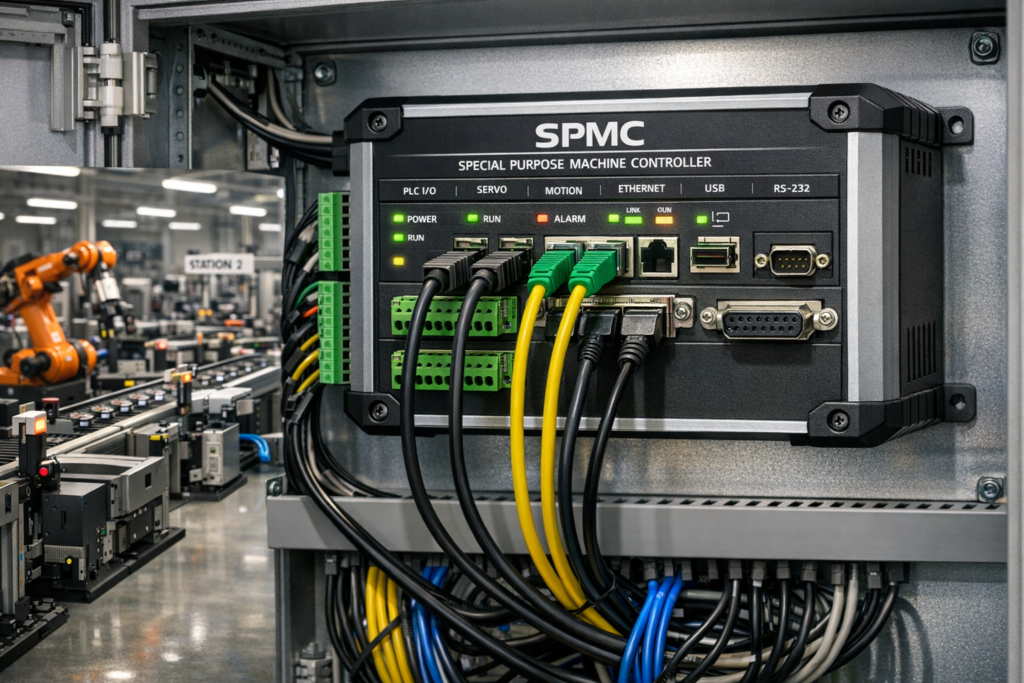
What Is a SPM Controllers?
A Special Purpose Machine Controller is a custom-built control unit. It controls one specific industrial process. Most of the time, it runs machines with many stations working together.
Unlike general PLCs, an SPMC focuses on a single task. Therefore, it works faster and more accurately.
In addition, the controller acts as the brain of the machine. It controls motion, sensors, and pneumatic or hydraulic systems. As a result, the machine delivers stable and repeatable performance.
Why SPM Controllers Are Important in Modern Automation
Today, automation needs more than simple control. It needs speed, timing, and accuracy.
SPM controllers help because they:
- Control complex processes
- Run many stations at the same time
- Process signals very quickly
- Reduce manual errors
Moreover, engineers design SPM controllers for a specific machine. Because of this, machines run smoothly with less downtime.
Why the Electronics Industry Needs SPM Controllers
Electronics manufacturing demands high precision. Parts like chips and PCBs are very small. Even a small mistake can cause failure. For this reason, electronics manufacturers rely on SPM controllers.
High Precision and Accuracy
First, electronics assembly needs micron-level accuracy. SPM controllers deliver this precision. As a result, defect rates drop during PCB assembly and soldering.
High Speed and Short Cycle Time
Next, production speed matters. SPM controllers can run 4 to 8 stations together. Therefore, output increases and cycle time reduces. In many cases, assembly errors drop by up to 30%.
Motion Control and Synchronization
In addition, many electronics machines need perfect timing. For example, robots must move with conveyors. SPM controllers manage this timing with high accuracy. As a result, motion stays smooth and stable.
Quality Inspection and Traceability
Also, SPM controllers connect with vision systems and sensors. They inspect every product in real time. At the same time, they store production data. Therefore, manufacturers gain full traceability and better quality control.
Fast Changeover for New Products
Finally, product designs change often. Engineers can quickly reprogram SPM controllers. Because of this, manufacturers switch products with less downtime.
Where Do Manufacturers Use SPM Controllers?
Manufacturers use SPM controllers in many electronics applications, such as:
- PCB assembly machines
- Terminal insertion systems
- Consumer electronics assembly lines
- Inspection and testing machines
- Packaging and labeling systems
In each case, the controller improves speed and accuracy.
Key Features of a High-Performance SPM Controller
A strong SPM controller includes:
- Multi-axis motion control
- Fast digital inputs and outputs
- Servo and stepper motor control
- Real-time sensor feedback
- Vision system support
- Data logging and diagnostics
Together, these features ensure reliable machine operation.
Easy Integration with Automation Systems
Special Purpose Machine controllers integrate easily with other systems. For example, they connect with:
- HMIs
- Servo drives and VFDs
- PLC-based systems
- Industrial networks
- Industry 4.0 and IoT platforms
As a result, teams can monitor machines live and plan maintenance early.
Benefits of Using a Dedicated SPM Controller
A dedicated Special Purpose Machine controller offers clear benefits:
- Higher accuracy
- Faster production
- Lower rejection rates
- Better machine uptime
- Long-term reliability
Therefore, manufacturers reduce costs and improve quality.
How Kathir Sudhir Automation Builds Smarter SPM Controllers
Kathir Sudhir Automation designs Special Purpose Machine Controllers for demanding industries. Their controllers focus on speed, precision, and reliability. Moreover, engineers customize these controllers for each application. They also ensure easy integration with existing automation systems. As a result, electronics manufacturers get a solution that fits their exact needs.
Conclusion
In summary, Special Purpose Machine Controllers support modern electronics manufacturing. They deliver speed, accuracy, and flexibility. Therefore, manufacturers who want better productivity and quality should choose a dedicated SPM controller.