
In simple terms: a double destoner machine with a vibratory feeder controller is a smart, industrial-grade solution that removes stones and heavy impurities from grains with high precision and consistency. It is designed for real-world mill conditions, where uniform feeding, reliability, and efficiency matter more than theory. In today’s grain-processing plants, this combination has become a practical necessity rather than a luxury.
What Is a Double Destoner Machine with Vibratory Feeder Controller?
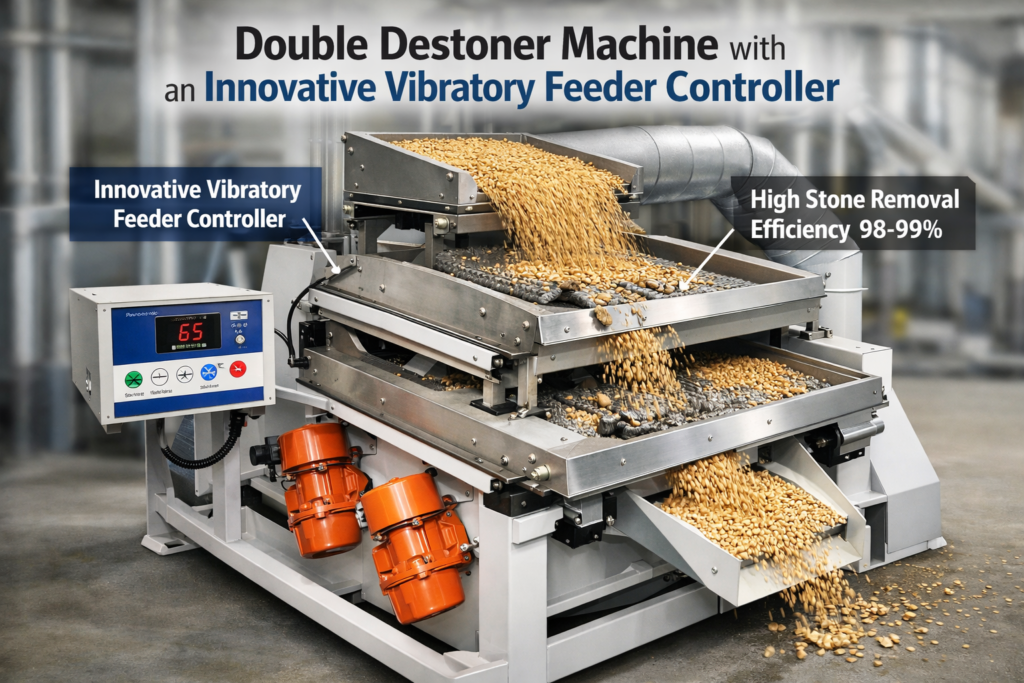
A double destoner machine is an advanced grain-cleaning unit that removes heavy contaminants such as stones, mud balls, and metal fragments from rice, wheat, pulses, and other grains. When paired with a vibratory feeder controller, the machine achieves uniform, controlled feeding—crucial for maintaining consistent separation efficiency.
At Kathir Sudhir Automation India Pvt Ltd, the vibratory feeder controller is specially designed to integrate with double destoner machines, ensuring stable operation even with non-free-flowing materials.
Key Aspects
- Cleaning Principle: Gravity separation + vibration
- Efficiency: 98–99% impurity removal
- Feed Control: Adjustable vibratory feeder controller
- Industries: Rice mills, flour mills, pulse processing, seed plants
Key Features and Technology
- Double-Deck Structure: Improves separation accuracy and throughput
- Vibratory Feeder Controller: Maintains uniform material flow without compaction
- Adjustable Parameters: Feed rate, deck inclination, and air volume
- Construction: Stainless steel (SS) or mild steel (MS) options
- Motor Power: Typically 1 HP to 5 HP (or higher for large capacities)
Comparison Table: Manual Feeding vs Vibratory Feeder Controller
| Aspect | Manual / Basic Feeding | Vibratory Feeder Controller |
|---|---|---|
| Feed Uniformity | Inconsistent | Highly uniform |
| Stone Removal Efficiency | Moderate | 98–99% |
| Material Flow | Can choke or surge | Smooth & controlled |
| Operator Dependency | High | Low |
| Long-Term Stability | Variable | Excellent |
How It Is Used (Practical Flow)
- Raw grain enters the vibratory Controller
- Controller regulates amplitude and feed rate
- Grain spreads evenly on the destoner deck
- Heavy impurities move in the opposite direction
- Clean grain exits separately with minimal loss
Steps to Follow (Installation & Operation)
- Level the machine and ensure proper deck inclination
- Connect and calibrate the vibratory feeder controller
- Adjust air flow based on grain type
- Start with low feed rate, then optimize
- Monitor output and fine-tune settings
Checklist for You (Before Buying)
- ✔ Required capacity (kg/h or tons/hour)
- ✔ Grain type (rice, wheat, pulses, seeds)
- ✔ Availability of vibratory feeder controller
- ✔ After-sales support and warranty
- ✔ Power consumption limits
Required Components
- Double destoner machine (double-deck)
- Vibratory feeder
- Vibratory feeder controller
- Drive motor (1–5 HP+)
- Blower / air system
- Control panel
Key Benefits
- Consistent and uniform feeding
- Higher destoning accuracy
- Reduced grain breakage
- Energy-efficient operation
- Suitable for both free-flowing and sticky materials
Advantages and Disadvantages
Advantages
- High separation efficiency (up to 99%)
- Reduced operator intervention
- Flexible for multiple grains
- Long service life
Disadvantages
- Higher initial investment than basic destoners
- Requires skilled setup for best results
Key Application Areas
- Rice mills
- Wheat and flour mills
- Pulse processing plants
- Seed cleaning units
- Grain export processing
Examples (Real-World Use)
- A rice mill increases output consistency by adding a vibratory feeder controller to its existing double destoner.
- A pulse processor reduces stone complaints from buyers by upgrading to controlled vibratory feeding.
FAQs
1. Best double destoner machines with vibratory controllers available in India?
Machines paired with dedicated vibratory feeder controllers from established automation suppliers offer the best consistency and durability.
2. What is the average cost of a double destoner machine in India?
Depending on capacity and build, prices typically range from mid to high six figures (INR).
3. How to choose a double destoner machine with vibratory feeder controller for grain processing?
Focus on capacity, feed control accuracy, separation efficiency, and service support.
4. Suppliers of industrial destoning equipment with vibratory Controllers?
Suppliers are concentrated in regions like Chennai and Coimbatore, known for grain-processing machinery.
5. Top manufacturers of double destoner machines with vibratory controllers in India?
Leading manufacturers often collaborate with automation specialists for feeder controllers.
6. How to choose the right vibratory feeder controller for a grain destoner?
Ensure compatibility with load, vibration frequency control, and grain characteristics.
7. Where to buy double destoner machines with vibratory controllers online?
Through verified manufacturer websites and industrial B2B platforms.
8. Manufacturers of high-capacity double destoners for rice mills?
Look for suppliers offering 5–10 tons/hour machines with proven references.
9. Price range for industrial double destoner machines with vibratory feeder controllers?
Prices vary based on capacity, automation level, and material of construction.
10. Specifications for advanced vibratory controllers?
Key specs include adjustable frequency, stable amplitude control, overload protection, and industrial-grade enclosure.
Conclusion
A double destoner machine with a vibratory feeder controller is a practical, high-efficiency solution for modern grain processing. By ensuring uniform feeding and precise separation, it improves product quality, reduces losses, and enhances overall plant reliability. When paired with a purpose-built controller from a trusted automation provider, it becomes a long-term asset for any serious grain-processing operation.