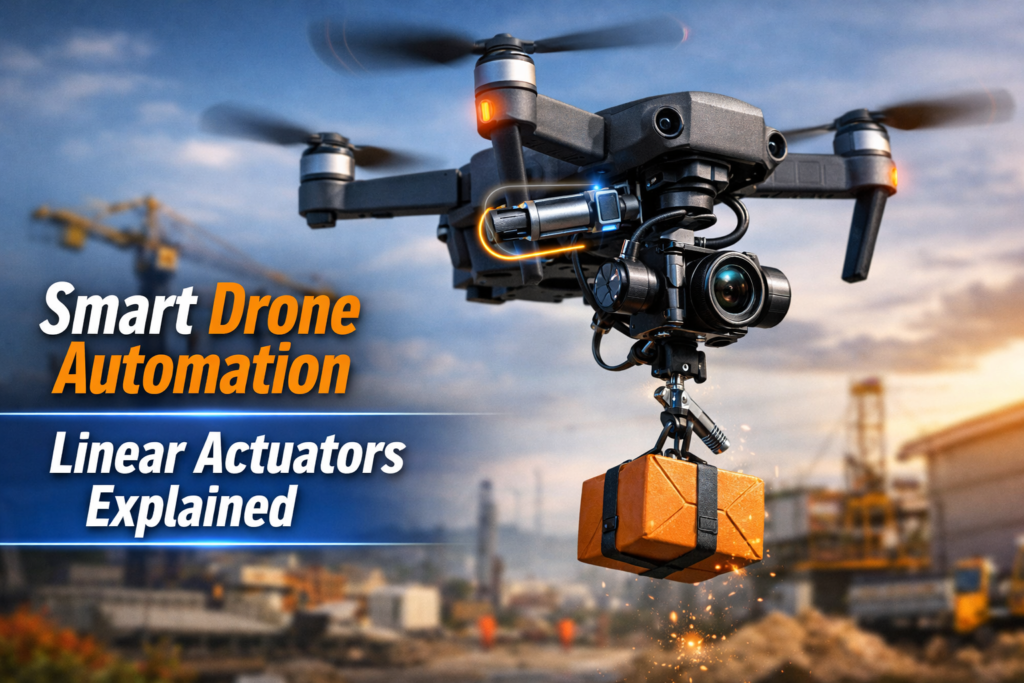
Drones are no longer just flying cameras—they are becoming intelligent machines capable of performing complex mechanical tasks. One of the key enablers behind this evolution is the linear actuator, which allows precise straight-line motion for functions like payload release, landing gear movement, and camera stabilization. By integrating compact and lightweight actuators, modern UAVs can achieve high precision, repeatability, and improved operational efficiency.
What is a Linear Actuator in Drones?
A linear actuator converts electrical energy into straight-line motion, unlike motors that produce rotation. In drones, these actuators are often micro-sized but powerful enough to handle critical tasks.
Key Aspects
- High thrust-to-weight ratio
- Compact and lightweight design
- Precise positioning and repeatability
- Easy integration with flight controllers
- Energy-efficient operation
How It is Used & Works
Linear actuators in drones operate by receiving signals from the flight controller (like ArduPilot). These signals control the actuator’s extension or retraction, enabling actions such as opening a payload latch or adjusting a camera mount.
Working Process:
- Signal sent from controller
- Actuator motor activates
- Lead screw or mechanism moves linearly
- Task (release, tilt, grip) is executed
Key Application Areas & Reasons
- Payload Release Systems – Precise dropping of supplies
- Retractable Landing Gear – Improves aerodynamics
- Camera Gimbals – Stabilization and angle adjustment
- Robotic Arms/Grippers – Pick-and-place operations
- Search & Rescue (SAR) – Delivering aid in emergencies
- Flight Control Surfaces – Used in fixed-wing UAVs
Required Components
- Micro linear actuator
- Flight controller (e.g., ArduPilot)
- Power supply (LiPo battery)
- Control unit (PWM/DroneCAN)
- Mounting brackets
- Wiring and connectors
Operations & Functions
- Extend/retract motion
- Position control
- Load handling
- Trigger-based activation
- Real-time adjustments
Key Features and Technology
- Sub-millimeter precision
- IP-rated protection (dust & water resistant)
- Lightweight aluminum or composite build
- Smart control protocols (DroneCAN, PWM)
- High durability for vibration environments
Key Benefits & Specifications
Benefits:
- Improved accuracy
- Automation of mechanical tasks
- Increased drone functionality
- Reduced manual intervention
Specifications (Typical):
- Stroke length: 10mm – 100mm
- Force: 10N – 200N
- Voltage: 12V – 24V
- Speed: 4–40 mm/s
Advantages and Disadvantages
Advantages
- High precision movement
- Compact and lightweight
- Easy integration
- Reliable and repeatable
Disadvantages
- Limited speed compared to rotary motors
- Power consumption considerations
- Requires proper mounting and calibration
Comparison Table
| Feature | Linear Actuator | Servo Motor |
|---|---|---|
| Motion Type | Linear | Rotary |
| Precision | Very High | Moderate |
| Load Handling | High | Medium |
| Complexity | Medium | Low |
| Use Case | Payload, landing gear | Camera tilt, control |
Steps to Follow (Integration Guide)
- Select suitable actuator (size & force)
- Mount securely on drone frame
- Connect to flight controller
- Configure control signals (PWM/DroneCAN)
- Test movement and calibration
- Perform flight testing
Checklist for You
- Correct actuator size selected
- Weight within drone capacity
- Proper power supply available
- Secure mounting done
- Signal compatibility verified
- Tested before deployment
Examples
- Delivery drones dropping medical supplies
- Agricultural drones releasing seeds/fertilizers
- Inspection drones using robotic grippers
- Camera drones with retractable landing gear
Key Application Insights from Industry
- Kathir Sudhir Automation India Pvt Ltd – Control units for actuators
- electricactuator.in – Remote control solutions
- linearactuator.shop – Wide range of actuator types
FAQs
1. Which is the best linear actuator for drone payload release in India?
Micro linear actuators with high thrust-to-weight ratio from trusted suppliers like Kathir Sudhir Automation are ideal.
2. What are the advantages of using linear actuators in drone design?
They provide precise motion, automation, and enable complex mechanical operations.
3. How to integrate a linear actuator with a quadcopter frame?
Mount securely, connect to the controller, configure signals, and test functionality.
4. How do miniature linear actuators enhance drone camera stability?
They enable fine adjustments and reduce vibrations for smoother imaging.
5. Who are the top Indian suppliers of linear actuator for drone applications?
Kathir Sudhir Automation, electricactuator.in, and linearactuator.shop.
6. Where can I find suppliers of compact linear actuator for DIY drone projects?
Online actuator stores and specialized automation companies offer compact models.
7. Where can I find affordable drones with built-in linear actuator for camera tilt?
Look for professional-grade drones or custom-built UAV solutions.
8. Explain the role of linear actuator in precise drone payload deployment systems.
They ensure controlled and accurate release of payloads at exact locations.
9. What is the guide to installing a linear actuator on a drone arm?
Use proper brackets, align correctly, connect wiring, and calibrate movement.
10. What are reliable brands for small electric linear actuator used in UAVs?
Brands offering micro actuators with durability and precision are recommended.
Conclusion
Linear actuators are transforming drones from simple flying devices into multifunctional robotic systems. Their ability to deliver precise, reliable linear motion makes them essential for advanced UAV applications like payload delivery, stabilization, and automation. As drone technology continues to evolve, integrating high-quality actuators will be a key factor in achieving smarter, more efficient aerial solutions.
Related Articles:
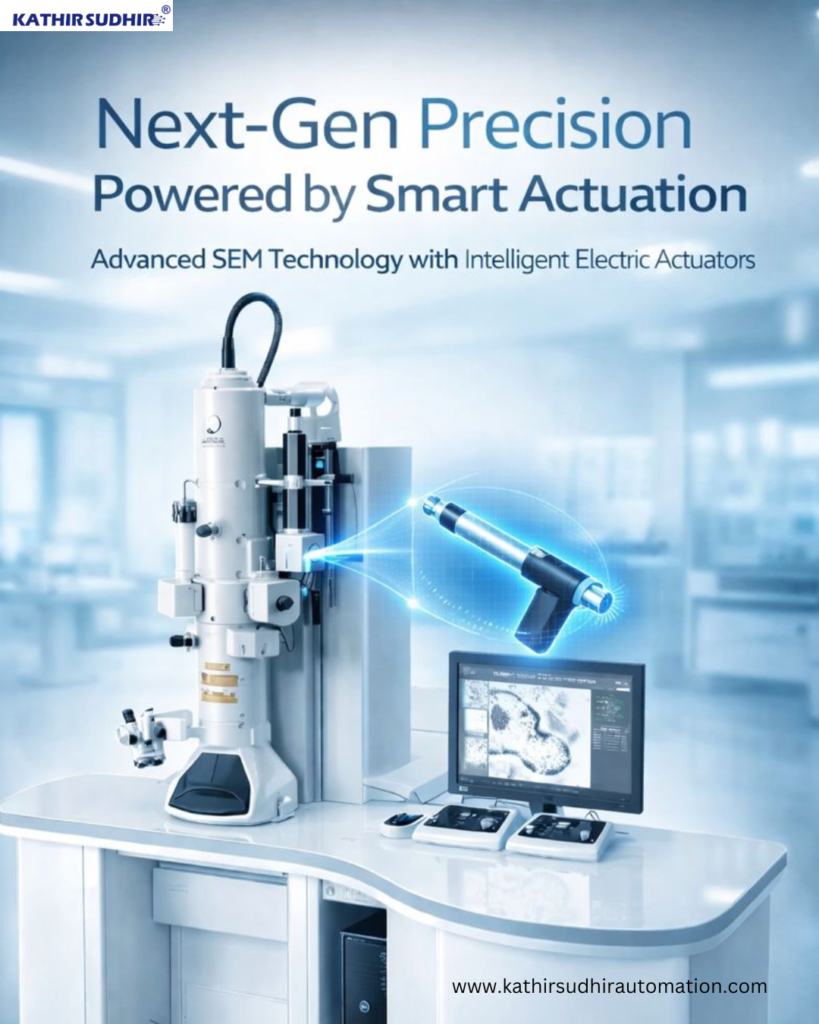
How the Medical Lab SEM Using Powerful Linear Actuator?
Scanning Electron Microscopes (SEMs) are widely used in medical laboratories. They help scientists study cells, tissues, and tiny particles at very high resolution. However, this level of detail is only possible because of precise motion control.