
Forest fires spread fast. Delays in detection cost land, wildlife, and lives. An SMS alert system solves this by sending instant warnings with location data, helping teams act within minutes.
What Is an SMS Alert System for Forest Fires
An SMS alert system detects fire signals and sends instant text alerts to authorities and response teams.
It uses:
- Sensors or satellite feeds to detect fire
- A processor to validate the event
- A GSM module or server to send SMS alerts
How It Works in Real Time
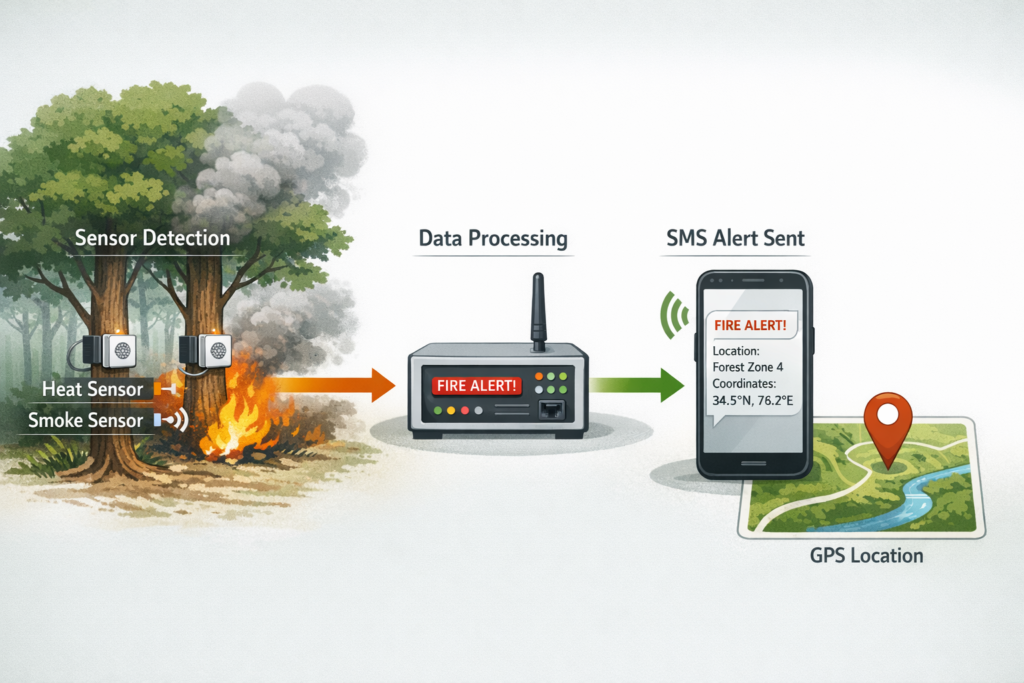
Step-by-step flow
- Detection
- Temperature sensors detect heat spikes
- Smoke sensors detect particles
- Flame sensors detect infrared signals
- Satellite systems track thermal anomalies
- Signal Processing
- A microcontroller or central server analyzes data
- Filters remove false alarms like industrial heat
- Triggering Alert
- Once thresholds are crossed, system activates GSM module
- SMS Dispatch
- Sends alerts with:
- Location (GPS coordinates)
- Time
- Severity level
- Sends alerts with:
- Continuous Monitoring
- Updates every 5 to 15 minutes
Key Components Required
- Flame sensor
- Smoke sensor
- Temperature sensor
- Microcontroller (Arduino or similar)
- GSM module
- Power supply
- Cloud or central server (optional)
- Satellite data integration (advanced systems)
Key Features and Technology
- Real-time SMS alerts
- GPS-based location tracking
- Threshold-based triggering
- Satellite integration
- Cloud-based monitoring dashboards
- Automatic call alerts for critical events
Comparison Table
| Feature | Sensor-Based System | Satellite-Based System |
|---|---|---|
| Detection Speed | Instant (local) | 5–15 minutes |
| Coverage Area | Limited | Very large |
| Accuracy | High (localized) | Moderate (needs filtering) |
| Cost | Low to medium | High |
| Maintenance | Required | Minimal |
Key Aspects You Should Know
- Works in remote areas without internet
- Uses GSM network for alerts
- Supports multi-recipient alerts
- Reduces human dependency
Key Application Areas
- Forest departments
- Wildlife reserves
- National parks
- Remote plantations
- Industrial zones near forests
Why these areas use it
- Hard to monitor manually
- High fire risk
- Need fast response
How It Is Used
- Installed across forest zones
- Connected to a central monitoring system
- Alerts sent to:
- Forest officers
- Fire departments
- Local authorities
Operations and Functions
- Detect abnormal environmental changes
- Validate fire signals
- Trigger alerts instantly
- Log historical data for analysis
Steps to Follow to Implement
- Identify high-risk zones
- Install sensors at key points
- Configure threshold values
- Connect GSM module
- Register phone numbers
- Test alert system
- Monitor and maintain
Checklist for You
- Do you cover all high-risk areas
- Are sensors calibrated
- Is GSM signal strong
- Are contacts updated
- Is backup power available
Examples
- A sensor detects sudden heat rise in dry forest
- Microcontroller processes signal
- GSM sends alert within seconds
- Fire team reaches site early and controls spread
Another case:
- Satellite detects thermal anomaly
- Central server validates data
- SMS sent to multiple departments
Key Benefits
- Fast response time
- Reduces fire spread
- Works in remote areas
- Improves safety
- Low operational cost
Advantages and Disadvantages
Advantages
- Instant alerts
- Accurate location tracking
- Scalable across large areas
- Works without internet
Disadvantages
- Depends on GSM network
- Sensor maintenance needed
- False alarms if not calibrated
Key Specifications
- Alert time: Seconds to minutes
- Coverage: Local to national level
- Power: Battery or solar
- Network: GSM
Conclusion
An SMS alert system turns fire detection into immediate action. It combines sensors, processing, and GSM communication to deliver real-time alerts with location data. This speed helps teams respond early, reduce damage, and protect ecosystems.
FAQ
1. How fast does an SMS fire alert system work
It sends alerts within seconds after detecting abnormal conditions.
2. Does it work without internet
Yes. It uses GSM networks, not internet.
3. What sensors are used in forest fire detection
Flame, smoke, and temperature sensors.
4. Can satellite data improve detection
Yes. It helps monitor large areas and detect thermal anomalies.
5. How accurate are SMS fire alerts
High accuracy when sensors are calibrated and filters are applied.
6. Who receives the SMS alerts
Forest officials, emergency teams, and registered contacts.
7. Can it cover large forest areas
Yes. Using satellite systems or multiple sensor nodes.
8. What is the cost of implementation
Depends on scale. Small systems are low cost, large networks cost more.
9. How often does the system update
Usually every 5 to 15 minutes in advanced systems.
10. Can it reduce forest fire damage
Yes. Early alerts lead to faster response and containment.

