
Agriculture is rapidly shifting towards automation and precision farming, with drones and robotics playing a vital role in boosting productivity. From monitoring crops to automating field operations, technology is revolutionizing how farmers work. At the core of many of these innovations are electric linear actuators—compact, reliable, and efficient devices that enable precise movement and control.
Why Actuators Matter in Agricultural Technology
Agricultural drones and robots must perform a wide range of tasks in challenging environments. This requires:
- Lightweight yet powerful motion systems
- High precision for delicate tasks
- Durability to withstand dust, moisture, and vibration
Electric linear actuators provide all of these features, making them essential for modern agricultural automation.
Applications of Linear Actuators in Agricultural Drones & Robotics
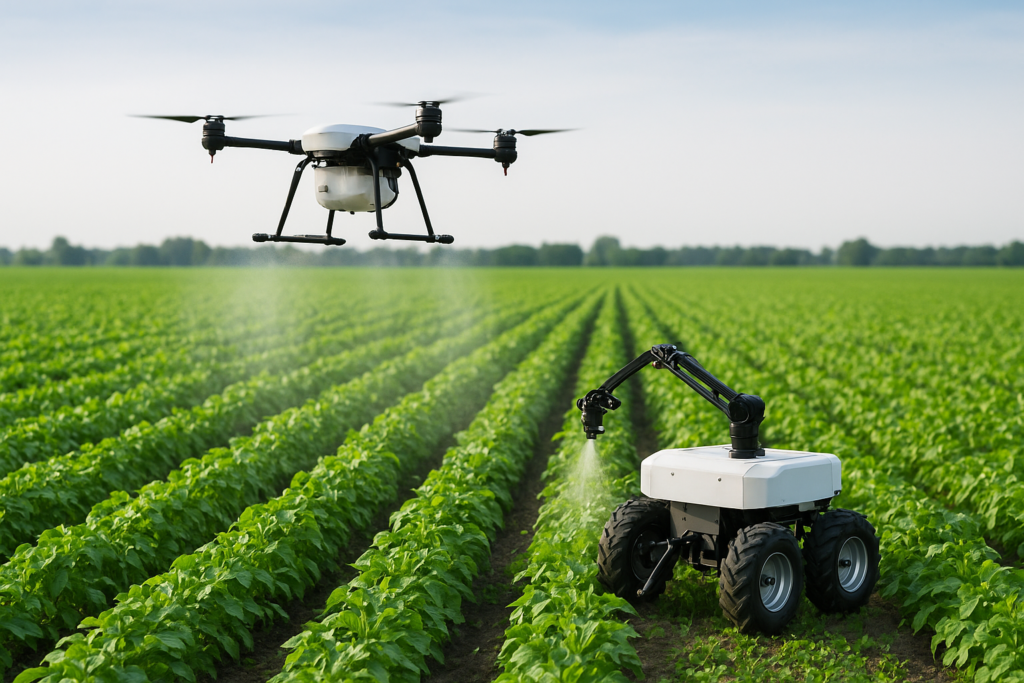
- Drone Spraying Systems
Actuators adjust nozzles and spray angles, ensuring even distribution of fertilizers, pesticides, and water. - Robotic Arms for Harvesting
Agricultural robots use actuators to control gripping and cutting tools for fruits and vegetables, allowing damage-free harvesting. - Camera & Sensor Positioning
Actuators adjust cameras and sensors on drones, enabling precise aerial imaging for crop health monitoring. - Autonomous Planting Systems
Robots with actuators can place seeds accurately at controlled depths and spacing, improving yield efficiency. - Livestock & Farm Equipment Automation
Beyond crops, actuators also assist in automating feeders, gates, and ventilation systems in smart farming.
Advantages of Using Electric Linear Actuators
- Lightweight & Compact – Perfect for drones where weight is critical.
- Energy Efficient – Consumes less power, extending battery life.
- Precise Control – Ensures accurate spraying, cutting, or lifting.
- Durability – Resistant to dust, water, and harsh weather conditions.
- Low Maintenance – More reliable than hydraulic or pneumatic systems.
The Future of Farming with Actuator-Powered Drones & Robots
As AI and IoT technologies advance, actuators will become even smarter—working with data-driven systems to perform fully autonomous tasks. Farmers will soon see drones adjusting themselves for weather conditions or robots fine-tuning their harvesting techniques based on crop type.
Conclusion
From spraying and planting to harvesting and monitoring, electric linear actuators are key enablers of agricultural drones and robotics. By offering precision, efficiency, and reliability, they are helping farmers increase productivity while reducing manual labor.
For the future of farming, actuators are not just components—they are the driving force of agricultural innovation.
Yeah, I’ve seen it around.