
Mechanical pencil cap manufacturing demands speed, accuracy, and smooth material handling. Even a small feeding error can create jams, scratches, or inconsistent production output.
Industrial vibratory feeder controllers solve this problem by controlling vibration intensity, feeding speed, and part orientation with precision. This guide explains how these controllers work, their features, specifications, benefits, and how to choose the right controller for mechanical pencil cap applications.
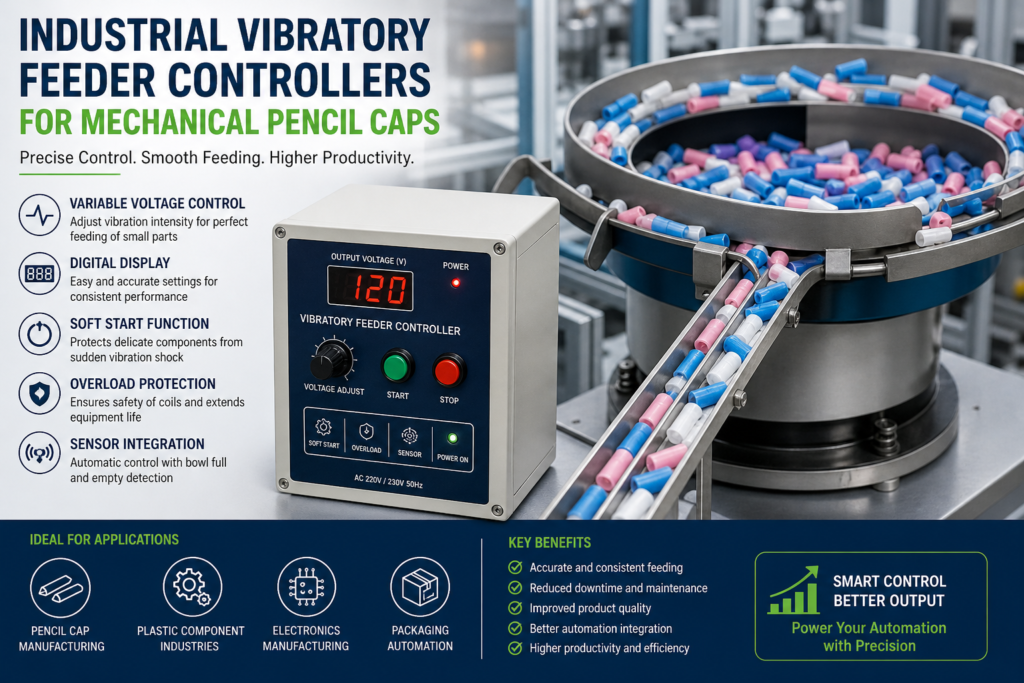
Overview of Industrial Vibratory Feeder Controllers
Industrial vibratory feeder controllers are electronic devices used to regulate the electromagnetic drive unit in vibratory bowl feeders. They help maintain smooth and controlled feeding of lightweight components like mechanical pencil caps.
For delicate plastic parts, the controller must provide:
- Stable vibration control
- Gentle part handling
- Consistent feeding speed
- Protection against overload and power fluctuation
- Sensor integration for automation
These controllers are widely used in:
- Pencil manufacturing
- Plastic molding industries
- Packaging automation
- Assembly lines
- Electronic component feeding
Why Mechanical Pencil Caps Need Precision Feeding
Mechanical pencil caps are:
- Lightweight
- Small in size
- Sensitive to excessive vibration
- Prone to misalignment
- Easily scratched or jammed
A standard uncontrolled feeder often causes:
- Feeding inconsistency
- Product damage
- Production stoppage
- Overflowing tracks
- Coil overheating
A high-quality vibratory feeder controller prevents these problems through accurate voltage and frequency regulation.
Key Features of Feed Controllers for Pencil Caps
1. Variable Voltage Control
Variable voltage adjustment helps operators fine-tune vibration intensity based on:
- Cap size
- Material weight
- Surface texture
- Bowl feeder design
This reduces bouncing and improves orientation accuracy.
2. Digital Control Panel
Modern controllers include digital displays for accurate parameter settings.
Benefits include:
- Easy operation
- Repeatable settings
- Better process control
- Quick troubleshooting
3. Soft Start Function
Soft start gradually increases vibration when the machine begins operation.
This helps:
- Protect delicate pencil caps
- Prevent sudden feeder shocks
- Extend feeder lifespan
4. Constant Voltage Technology
Constant voltage output maintains stable feeding even during input power fluctuations.
This ensures:
- Uniform feeding rate
- Consistent production quality
- Reduced downtime
5. Overload Protection
Protects the electromagnetic coil from overheating or burnout. Important in continuous production environments.
6. Sensor Integration
Advanced controllers support sensors for:
- Bowl full detection
- Empty track detection
- Overflow prevention
- Automated stop/start operation
How Industrial Vibratory Feeder Controllers Work
The controller regulates electrical power supplied to the electromagnetic drive unit.
Working Process
- AC power enters the controller
- Controller adjusts output voltage.
- Electromagnetic coil generates vibration
- Bowl feeder moves pencil caps in a controlled path
- Sensors monitor feeding status
- Controller automatically adjusts or pauses feeding
The result is stable and precise feeding of small plastic components.
Comparison Table: Digital vs Analog Vibratory Feeder Controllers
| Feature | Digital Controller | Analog Controller |
|---|---|---|
| Precision Control | High | Moderate |
| Display | Digital Display | Manual Knob |
| Sensor Integration | Supported | Limited |
| Automation Compatibility | Excellent | Basic |
| Voltage Stability | Better | Standard |
| Ease of Operation | User-Friendly | Simple |
| Cost | Higher | Lower |
| Best Use | Precision components | General feeding |
Top Controller Types for Mechanical Pencil Caps
Variable Voltage Controller (0–230V Digital)
Suitable for:
- Small plastic parts
- Precision orientation
- Controlled vibration applications
Wall Mounting Vibratory Feeder Controller
Benefits:
- Compact installation
- Easy maintenance
- Operator-friendly controls
Metal Box Vibratory Feeder Controller
Preferred for:
- Industrial environments
- Long operational hours
- Better durability
Custom Controllers from Kathir Sudhir Automation
Designed specifically for:
- Cap feeding systems
- Lightweight components
- Automation integration
Key Specifications to Consider
| Specification | Typical Value |
|---|---|
| Input Voltage | 220V / 230V AC |
| Phase Type | Single Phase |
| Output Current | 3A – 6A |
| Output Voltage | 0 – 230V Adjustable |
| Display Type | Digital 3-Digit |
| Protection | Overload Protection |
| Mounting Type | Wall / Panel Mount |
| Sensor Support | Yes |
Required Components in a Vibratory Feeding System
A complete feeding setup usually includes:
- Vibratory bowl feeder
- Electromagnetic drive unit
- Vibratory feeder controller
- Sensors
- Track assembly
- Mounting base
- Power supply unit
Key Application Areas
Mechanical Pencil Manufacturing
Used for:
- Cap feeding
- Clip orientation
- Automated assembly
Plastic Component Industries
Ideal for:
- Tiny molded parts
- Lightweight plastic items
Electronics Manufacturing
Used for feeding:
- Connectors
- Small housings
- Precision parts
Packaging Automation
Supports:
- High-speed packaging lines
- Small component sorting
Advantages of Vibratory Feeder Controllers
Benefits
- Accurate feeding control
- Reduced production errors
- Gentle component handling
- Improved automation
- Stable production speed
- Longer equipment lifespan
- Lower manual intervention
Business Advantages
- Increased productivity
- Reduced maintenance cost
- Better product quality
- Higher operational efficiency
Disadvantages to Consider
- Higher cost for advanced digital models
- Requires proper parameter setup
- Sensor integration may increase installation cost
- Incorrect tuning may affect feeding accuracy
Purchase Guide: Choosing the Right Controller
Step 1: Understand Component Characteristics
Mechanical pencil caps are:
- Lightweight
- Delicate
- Sensitive to vibration intensity
Choose a controller with precise low-intensity control.
Step 2: Match Power Requirements
Check bowl feeder coil rating.
Most small feeder systems require:
- 3A to 6A output current
Step 3: Choose Control Type
For precision applications:
- Digital controllers are preferred
For basic operations:
- Analog controllers may be enough
Step 4: Check Sensor Compatibility
Ensure compatibility with:
- Bowl full sensors
- Empty track sensors
- Automation PLC systems
Step 5: Consider Environmental Conditions
For dusty industrial areas:
- Choose IP-rated controllers like IP55
Step 6: Verify Safety Features
Look for:
- Overload protection
- Constant voltage
- Soft start technology
Checklist Before Buying
Your Controller Should Have
- Digital display
- Adjustable voltage control
- Overload protection
- Soft start function
- Sensor support
- Stable output voltage
- Industrial-grade enclosure
Avoid Controllers Without
- Voltage stabilization
- Thermal protection
- Precision adjustment
Key Prevention Techniques for Smooth Feeding
Prevent Jamming
- Use proper vibration tuning
- Maintain bowl cleanliness
- Avoid excessive vibration
Prevent Component Damage
- Enable soft start
- Use low-intensity settings
- Regularly inspect feeder tracks
Prevent Coil Failure
- Use overload protection
- Match controller current rating properly
Compliance and Best Practices
Follow these practices for reliable operation:
- Use proper grounding
- Install surge protection
- Maintain recommended voltage range
- Inspect sensors periodically
- Perform regular coil testing
Best industrial setups also follow:
- Electrical safety standards
- Industrial automation guidelines
- Preventive maintenance schedules
Pro Tip
For mechanical pencil cap feeding, always prioritize precise voltage adjustment over maximum power output. Gentle and stable vibration delivers better orientation accuracy and fewer feeding interruptions.
Pricing Overview
Small and Standard Controllers
- Lower cost
- Suitable for basic feeding applications
Advanced Digital Controllers
- Higher price
- Better automation support
- Improved precision
- Enhanced safety functions
Pricing varies depending on:
- Current capacity
- Digital features
- Sensor integration
- Build quality
Conclusion
Industrial vibratory feeder controllers play a critical role in the precise handling of mechanical pencil caps and other lightweight plastic components. The right controller improves feeding consistency, prevents product damage, and supports efficient automation.
For modern manufacturing lines, digital controllers with soft start, overload protection, constant voltage control, and sensor integration deliver the best results. Choosing the correct specifications and features helps reduce downtime, improve product quality, and increase production efficiency.
FAQs
1. Which is the best industrial vibratory feeder controller for small components in India?
Digital vibratory feeder controllers with variable voltage control, overload protection, and sensor integration are widely preferred for small components. Kathir Sudhir Automation offers suitable models for precision applications.
2. What are the key features of advanced vibratory feeder controllers for small components?
Key features include:
- Digital display
- Variable voltage control
- Soft start
- Constant voltage output
- Sensor compatibility
- Overload protection
3. How to choose an industrial vibratory feeder controller for small parts?
Check:
- Component weight
- Bowl feeder power rating
- Required output current
- Sensor integration needs
- Precision control capability
4. Compare specifications of digital versus analog controllers for miniature part feeders.
Digital controllers provide better precision, automation compatibility, and voltage stability, while analog controllers are simpler and lower in cost.
5. Who are the top manufacturers of industrial vibratory feeder controllers for small components?
Popular manufacturers include:
- Kathir Sudhir Automation
- Industrial feeder controller suppliers
- Custom automation solution providers
6. Where can I find reliable suppliers of industrial vibratory feeder controllers in India?
Reliable suppliers are available through industrial automation manufacturers, automation integrators, and specialized feeder controller companies like Kathir Sudhir Automation.
7. What features should I look for in a vibratory feeder controller for tiny components?
Important features include:
- Precise voltage adjustment
- Soft start
- Constant voltage
- Sensor support
- Digital control panel
8. Purchase guide for selecting a vibratory feeder controller for delicate components.
Select controllers with:
- Low-intensity vibration control
- Stable voltage output
- Overload protection
- Automation compatibility
- Industrial-grade build quality
9. Where to buy industrial vibratory feeder controllers for small components online?
You can purchase them from industrial automation websites, feeder system manufacturers, and specialized automation equipment suppliers.
10. What are the benefits of using smart controllers for automated small parts feeding systems?
Benefits include:
- Better feeding accuracy
- Reduced downtime
- Automated control
- Lower maintenance
- Higher production efficiency
- Improved product handling