
Precision and speed define modern plastic toy manufacturing. Vibrator feeder controllers ensure accurate handling and orientation of tiny LEGO components, enabling smooth, automated assembly. This guide helps you navigate the right solution for reliable and efficient production.
Why Vibrator Feeder Controllers Matter in LEGO Automation
Vibrator feeder controllers regulate vibration intensity to move and orient small plastic parts without jamming or damage. They ensure consistent feeding, which is essential for automated sorting and assembly systems.
Key Functions
- Control vibration Voltage
- Maintain uniform material flow
- Prevent part damage and misalignment
- Synchronize with robotic automation systems
- Improve production efficiency and accuracy
How It Works
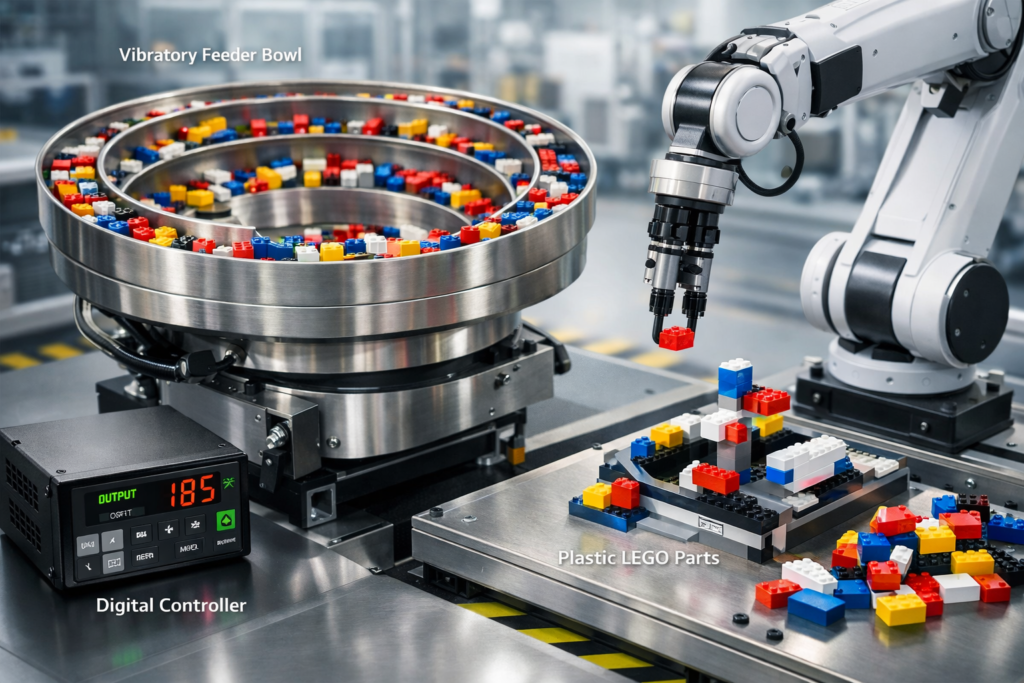
Vibratory feeder controllers manage electromagnetic drives that propel plastic LEGO parts along a circular track.
Working Principle
- The controller supplies regulated power to the electromagnetic coil.
- The coil generates controlled vibrations.
- Parts move upward along the spiral track.
- Components are oriented and sorted based on shape and size.
- Correctly aligned pieces proceed to the assembly line.
Operational Flow
- Power input activates the controller.
- The electromagnetic drive produces vibration.
- Plastic LEGO pieces move along the feeder bowl.
- Sensors detect alignment and regulate flow.
- Robots or conveyors receive sorted parts.
Key Features for LEGO Automation
- Variable Voltage Control: Enables precise adjustments from 0–230 V to handle lightweight plastic components without bouncing or damage.
- Automatic Regulation: Maintains steady vibration levels despite variations in load.
- Soft Start Technology: Prevents sudden jolts to fragile parts.
- Digital Control Interface: Allows precise tuning and monitoring.
- Safety and Protection: IP54-rated enclosures ensure durability in dusty environments.
- Energy Efficiency: Optimizes power consumption for cost-effective operations.
Recommended Controller Types
| Controller Type | Best For | Advantages | Limitations |
|---|---|---|---|
| Digital Vibratory Feeder Controllers | Multiple LEGO part sizes | High precision, automation-ready | Higher initial cost |
| Analog Vibratory Feeder Controllers | Standard brick feeding | Cost-effective and reliable | Limited flexibility |
| Microcontroller-Based Controllers | Advanced automation | Smart integration and monitoring | Requires technical expertise |
Key Applications and Reasons
Application Areas
- Plastic LEGO toy assembly lines
- Sorting and orientation of miniature parts
- Packaging and counting systems
- Injection molding facilities
- Robotics and pick-and-place automation
Reasons for Use
- Ensures consistent material flow
- Reduces manual handling errors
- Enhances productivity
- Improves product quality
- Minimizes downtime
Key Aspects to Consider
- Precision Control: Essential for handling lightweight plastic parts.
- Integration Capability: Compatible with PLCs and robotic systems.
- Durability: Designed for continuous industrial operations.
- Energy Efficiency: Reduces operational costs.
- Safety Features: Protects equipment and components.
Required Components
- Vibratory feeder bowl
- Vibrator feeder controller
- Electromagnetic drive unit
- Sensors and automation systems
- Control panel and wiring
- Mounting springs and base plate
Operations and Functions
| Operation | Function |
|---|---|
| Voltage Regulation | Controls vibration intensity |
| Voltage Adjustment | Optimizes feeding speed |
| Load Compensation | Maintains consistent flow |
| Soft Start | Prevents sudden shocks |
| Overload Protection | Ensures system safety |
| Automation Integration | Synchronizes with PLCs and robots |
Key Benefits and Specifications
Benefits
- Increased production speed
- Accurate orientation of plastic LEGO parts
- Reduced labor costs
- Improved process reliability
- Enhanced automation efficiency
Typical Specifications
| Parameter | Specification |
|---|---|
| Input Voltage | 230 V AC |
| Output Voltage | 0–230 V |
| Protection Rating | IP54 |
| Control Type | Analog/Digital |
| Frequency Range | 50–60 Hz |
| Applications | Plastic component automation |
Advantages and Disadvantages
Advantages
- High precision and efficiency
- Reduced operational downtime
- Smooth integration with automated systems
- Energy-efficient operation
- Improved product quality
Disadvantages
- Higher initial investment for digital models
- Requires technical setup and calibration
- Periodic maintenance needed
Steps to Follow for Implementation
- Identify production requirements.
- Select a compatible vibratory feeder bowl.
- Choose the appropriate controller type.
- Integrate with sensors and automation systems.
- Configure voltage and frequency settings.
- Test and calibrate the system.
- Monitor performance and optimize operations.
Checklist for You
- Define LEGO component size and weight.
- Verify controller compatibility with the feeder bowl.
- Confirm IP-rated protection for industrial environments.
- Evaluate energy efficiency and safety features.
- Request technical support and documentation.
- Compare cost and performance before purchase.
Practical Examples
Example 1: LEGO Sorting Line
A digital controller ensures precise vibration, allowing robots to pick and place correctly oriented bricks.
Example 2: High-Speed Packaging Unit
An analog controller maintains consistent feed rates for standard plastic components.
Example 3: Smart Manufacturing Facility
A microcontroller-based system integrates with IoT-enabled production lines for real-time monitoring.
Comparison of Controller Technologies
| Feature | Analog Controller | Digital Controller |
|---|---|---|
| Precision | Moderate | High |
| Automation Compatibility | Limited | Excellent |
| Cost | Lower | Higher |
| Ease of Operation | Simple | Advanced |
| Flexibility | Limited | Highly Flexible |
| Energy Efficiency | Moderate | High |
Internal Links for Further Reading
- https://indigenisation.in/
- https://indigenisation.in/indigenous-manufacturing-in-india/
- https://indigenisation.in/make-in-india-initiative/
People Also Ask
1. Which is the best vibrator feeder controller for automating plastic toy assembly lines?
Digital vibratory feeder controllers offer high precision, automation compatibility, and consistent performance for plastic toy manufacturing.
2. What are the fundamental principles of vibratory feeder controllers?
They regulate voltage to control electromagnetic vibrations, ensuring smooth and consistent movement of parts.
3. Where to buy industrial vibrator feeder controllers for LEGO toy manufacturing in India?
Reliable manufacturers and automation solution providers in India offer high-quality controllers suitable for industrial applications.
4. How do vibratory feeder systems enhance automation for small plastic parts?
They automate sorting, orientation, and feeding, reducing manual labor and improving production speed.
5. Top companies supplying vibrator feeder controllers for plastic toy automation
Leading suppliers include specialized industrial automation companies and indigenous manufacturers in India.
6. Who is the leading manufacturer of industrial vibratory feeder controllers in India?
Several Indian automation companies provide high-performance and cost-effective solutions tailored to industry needs.
7. How do vibrator feeder controllers improve efficiency in plastic LEGO toy production?
They ensure continuous feeding, reduce downtime, and enhance assembly line productivity.
8. Who are the suppliers of automation equipment for plastic toy component handling?
Industrial automation firms and feeder system manufacturers supply customized solutions for plastic component handling.
9. How to compare features of popular vibrator feeder controllers for plastic toy automation?
Evaluate voltage control, automation compatibility, safety features, precision, durability, and cost-effectiveness.
10. How to analyse the cost of different vibratory feeder controller technologies?
Consider initial investment, maintenance costs, energy consumption, performance, and long-term operational benefits.
Conclusion
Vibrator feeder controllers play a critical role in plastic LEGO toy automation by ensuring precision, consistency, and efficiency. Whether you choose analog or digital solutions, selecting the right controller enhances productivity and supports seamless industrial automation. For dependable performance and integration-ready systems, explore advanced vibratory feeder controller solutions tailored to modern manufacturing needs.