
Introduction
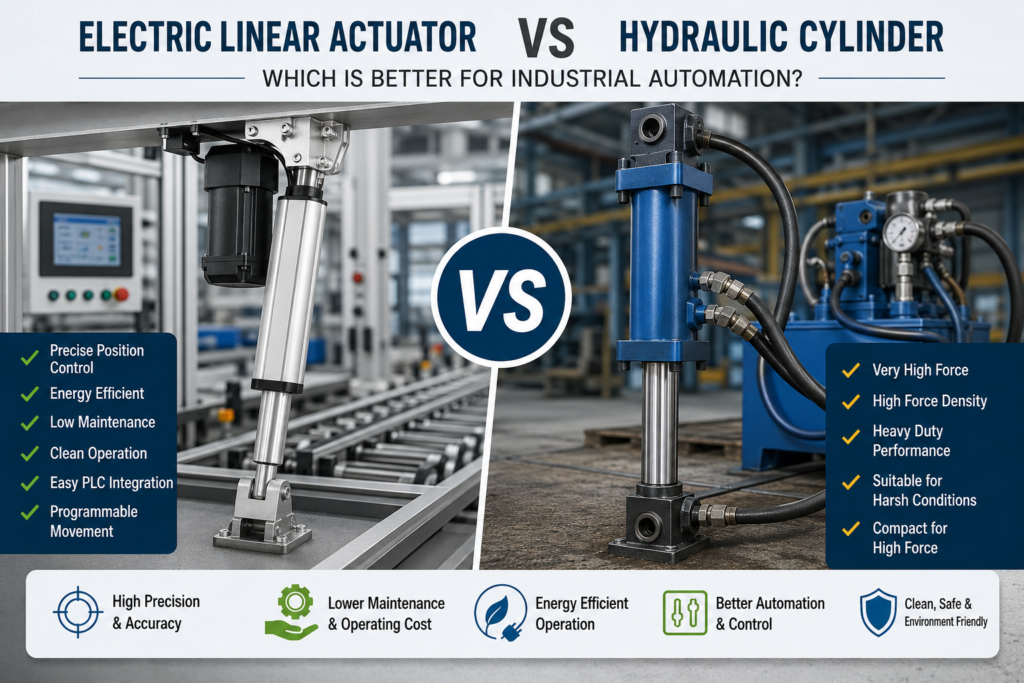
Choosing the right linear motion system is important when designing an automated machine. When comparing options, electric linear actuator vs hydraulic cylinder, both suit lifting, pushing, and positioning tasks.
The better option depends on your application. Electric linear actuators are strong in precision, programmable motion, clean operation, and easy automation. Hydraulic cylinders remain valuable for applications requiring extremely high force, rugged operation, and high force density.
In this guide, you will learn the key differences between an electric linear actuator and a hydraulic cylinder and how to select the right technology for your industrial automation project.
What Is an Electric Linear Actuator?
An electric linear actuator converts electrical energy into controlled linear movement.
A typical system uses:
- Electric motor
- Lead screw or ball screw
- Gear mechanism
- Linear rod
- Position sensors or feedback
- Controller or drive
The motor rotates the screw, which converts rotary motion into linear movement. Depending on the design, the actuator extends or retracts to move a machine component.
Electric actuators work well with PLCs, switches, remote controls, sensors, servo drives, and other automation systems.
They provide control over position, speed, acceleration, and motion sequences.
What Is a Hydraulic Cylinder?
A hydraulic cylinder uses pressurized hydraulic fluid to create linear movement.
A typical hydraulic system includes:
- Hydraulic cylinder
- Hydraulic pump
- Oil reservoir
- Valves
- Hoses or pipes
- Filters
- Pressure-control components
When pressurized fluid enters the cylinder, it pushes the piston and extends or retracts the rod.
Hydraulic cylinders are widely used for heavy-duty lifting, pressing, clamping, construction machinery, and applications where high force is required in a compact space.
Electric Linear Actuator vs Hydraulic Cylinder: Key Differences
| Feature | Electric Linear Actuator | Hydraulic Cylinder |
|---|---|---|
| Power source | Electricity | Pressurized hydraulic fluid |
| Motion control | Precise and programmable | Requires valves and control systems |
| Position control | High | Possible, but requires additional feedback and control |
| Installation | Wiring and mechanical mounting | Pump, valves, hoses, reservoir and cylinder |
| Maintenance | Generally lower | Higher due to fluid, seals, filters and hoses |
| Leakage | No hydraulic oil leakage | Hydraulic fluid leakage is possible |
| Cleanliness | Clean operation | Requires hydraulic fluid |
| Energy use | Energy is primarily consumed during movement | Pumping and pressure losses add energy consumption |
| Automation integration | Easy with PLCs and digital controls | Requires hydraulic and electronic interfaces |
| High-force applications | Medium to high, depending on design | Excellent |
| Programmable movement | Excellent | More complex |
| Multiple position control | Easy | Requires additional control hardware |
The exact performance depends on actuator design, load, duty cycle, control system, and operating conditions. Research comparing actuation technologies also shows that electric systems offer strong performance in controlled positioning and power consumption, while hydraulic systems retain advantages in high-force applications.
1. Precision and Position Control
Precision is one of the biggest advantages of electric linear actuators.
You can configure an electric actuator for:
- Specific stroke positions
- Multiple stopping points
- Controlled speed
- Controlled acceleration and deceleration
- Repeatable movement
- Sensor-based feedback
- Automated positioning
This makes electric actuators suitable for CNC equipment, packaging machines, material handling systems, adjustable workstations, medical equipment, and special-purpose machines.
Hydraulic cylinders also support position control, but accurate programmable positioning generally requires additional sensors, valves, and control equipment.
2. Force and Load Capacity
Hydraulic cylinders have traditionally been preferred for extremely high-force applications.
They provide high force density and work well in:
- Industrial presses
- Heavy lifting equipment
- Construction machinery
- Heavy-duty clamping
- Large machinery
- High-load applications
Modern electric actuators also cover medium and high-force applications, but the required force, stroke, duty cycle, speed, and installation space must be evaluated before selecting one.
If your machine needs extremely high force within a small installation space, hydraulic technology remains a strong option.
3. Speed Control
Electric actuators provide direct control over movement speed.
You can program the actuator to:
- Start slowly
- Accelerate
- Move at a defined speed
- Decelerate
- Stop at a specific position
This is useful when a machine needs different speeds during one operating cycle.
Hydraulic cylinders also provide adjustable speed, but the control depends on hydraulic flow, pressure, valves, load, temperature, and system design.
4. Energy Efficiency
Energy consumption is an important factor in industrial automation.
Electric actuators transmit electrical energy directly through a motor and mechanical transmission. They generally consume energy according to the movement and load requirements.
Hydraulic systems require additional components such as pumps and valves. Pressure losses, throttling, leakage, and continuous pressure requirements can reduce overall efficiency.
A peer-reviewed comparison published in Scientific Reports found the electric system in its tested configuration showed the lowest power consumption among the compared actuation systems.
Your actual energy savings depend on the machine design, duty cycle, load, motor selection, control method, and operating hours.
5. Maintenance Requirements
Electric linear actuators have a relatively simple installation because they do not require hydraulic oil circuits.
Maintenance typically focuses on:
- Mechanical components
- Screw and nut
- Bearings
- Motor
- Sensors
- Electrical connections
Hydraulic systems require additional maintenance for:
- Hydraulic oil
- Filters
- Seals
- Hoses
- Valves
- Pumps
- Connections
- Leakage inspection
Hydraulic maintenance becomes more demanding as the system becomes larger and more complex.
6. Cleanliness
Electric linear actuators are useful where hydraulic fluid is undesirable.
Potential applications include:
- Food processing
- Laboratory equipment
- Medical equipment
- Clean manufacturing areas
- Packaging equipment
- Electronic manufacturing
Hydraulic systems require fluid containment and leak management.
For applications where cleanliness is a priority, an electric actuator provides a simpler solution.
7. Automation and PLC Integration
Modern industrial machines require communication between sensors, actuators, PLCs, HMIs, and control systems.
Electric linear actuators integrate well with electronic control systems. Depending on the actuator and controller, you can implement:
- Automatic positioning
- Limit control
- Position feedback
- Programmable stroke
- Speed control
- Sequential movement
- Remote operation
- Sensor-based movement
Hydraulic cylinders also work with automated systems, but the control architecture typically includes hydraulic valves, pressure systems, sensors, and electronic interfaces.
Electric actuation is therefore attractive for machines requiring programmable and repeatable motion.
8. Installation and System Complexity
An electric actuator generally requires mechanical mounting, electrical wiring, and a suitable control system.
A hydraulic cylinder requires a complete hydraulic circuit.
This often includes:
- Pump
- Motor
- Reservoir
- Hydraulic lines
- Valves
- Filters
- Pressure controls
- Cylinder
For a machine with several independent linear movements, replacing multiple hydraulic cylinders with electric actuators can simplify the overall architecture, depending on the application.
When Should You Choose an Electric Linear Actuator?
Choose an electric linear actuator when your application requires:
- Precise positioning
- Repeatable movement
- Programmable stroke
- Variable speed
- Easy PLC integration
- Clean operation
- Lower maintenance
- No hydraulic fluid
- Multiple programmed positions
- Automated machine adjustment
- Digital monitoring and feedback
Typical applications include:
- CNC machines
- Packaging machines
- Material handling systems
- Automated workstations
- Medical equipment
- Food processing machines
- Conveyor systems
- Solar tracking systems
- Industrial lifting systems
- Special-purpose machines
When Should You Choose a Hydraulic Cylinder?
A hydraulic cylinder is often suitable when your application requires:
- Extremely high force
- High force density
- Heavy-duty operation
- Shock-load resistance
- Compact high-force motion
- Existing hydraulic infrastructure
Typical applications include:
- Hydraulic presses
- Heavy lifting systems
- Construction equipment
- Large industrial machinery
- Heavy-duty clamping
- Material handling equipment
Hydraulic technology remains important for applications where high force and rugged operation are the primary requirements.
Electric Linear Actuator vs Hydraulic Cylinder: Which One Should You Choose?
There is no single solution for every machine.
Choose an electric linear actuator if your priority is:
Precision + programmable control + clean operation + simple automation + lower maintenance
Choose a hydraulic cylinder if your priority is:
Very high force + high force density + heavy-duty operation
For new industrial automation projects, electric linear actuators are often a strong choice when the machine requires accurate positioning and electronic control. Hydraulics remain a strong choice for heavy-duty, high-force applications.
How to Select the Right Electric Linear Actuator
Before selecting an electric linear actuator, define these parameters:
- Load or required force
- Stroke length
- Required speed
- Duty cycle
- Operating voltage
- Mounting arrangement
- Required accuracy
- Required repeatability
- Operating environment
- Feedback requirements
- Available installation space
- Control method
For example, if a machine needs to lift a platform repeatedly, you need to calculate the load, stroke, speed, duty cycle, mounting geometry, and safety requirements before selecting the actuator.
Do not select an actuator based only on maximum force.
Final Verdict
Electric linear actuators and hydraulic cylinders both have important roles in industrial automation.
Electric linear actuators are a strong choice for applications requiring precise positioning, programmable motion, clean operation, digital control, and simplified maintenance.
Hydraulic cylinders remain a strong choice for high-force and heavy-duty applications where force density and rugged performance are critical.
The right technology depends on your machine requirements, not on the actuator type alone.
For industrial automation projects, evaluate force, stroke, speed, duty cycle, precision, environment, control requirements, maintenance, and total operating cost before making your selection.
FAQs
Is an electric linear actuator better than a hydraulic cylinder?
For precision, programmable movement, clean operation, and electronic control, an electric linear actuator is often the better choice. For extremely high-force applications, hydraulic cylinders often remain advantageous.
Can an electric linear actuator replace a hydraulic cylinder?
In many applications, yes. You need to compare force, stroke, speed, duty cycle, mounting dimensions, environmental conditions, and control requirements before making the replacement.
Which is easier to maintain?
Electric linear actuators generally require less system-level maintenance because they do not require hydraulic oil, pumps, filters, hoses, or hydraulic valves.
Which actuator is better for PLC automation?
Electric linear actuators integrate naturally with PLC-based automation systems, especially when the machine requires programmable position, speed, feedback, and sequencing.
Which actuator is better for heavy loads?
Hydraulic cylinders remain highly effective for extremely heavy loads and high-force applications. High-force electric actuators are also available, so the application requirements should determine the final selection.